

Contrary to popular belief, Lorem Ipsum is not simply random text. It has roots in a piece of classical Latin literature from 45 BC, making it over 2000 years old.
For decades, the Chief Financial Officer (CFO) had a very clear domain: revenue, margins, cash flow, and the balance sheet. If the numbers reconciled and the financial auditors were happy, the job was done.
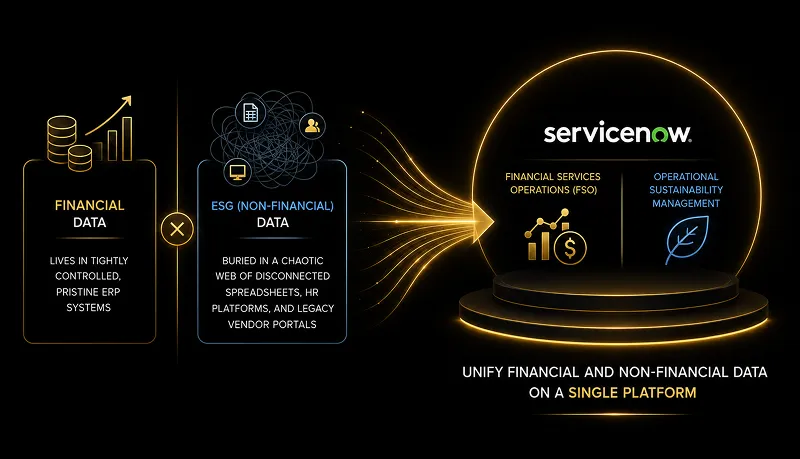
But as we navigate the complexities of 2026, the mandate of the CFO has fundamentally fractured. Global regulatory frameworks—from the EU’s Corporate Sustainability Reporting Directive (CSRD) to sweeping SEC climate disclosure mandates—have forced a harsh new reality upon the finance sector. Today, non-financial reporting (ESG) is held to the exact same audit standards as financial reporting. CFOs are now discovering that while their financial data lives in tightly controlled, pristine ERP systems, their ESG data is buried in a chaotic web of disconnected spreadsheets, HR platforms, and legacy vendor portals.
This disconnect is triggering a massive data hygiene crisis. You cannot sign off on an integrated corporate report if half of the data is unverified guesswork. To survive, finance leaders are turning to a powerful architectural advantage: unifying ServiceNow Financial Services Operations (FSO) with Operational Sustainability Management (formerly ESG Management).
As ServiceNow consultants at Mirroar, we help CFOs turn this regulatory burden into a strategic advantage. Here is how unifying financial and non-financial data on a single platform is changing the game in 2026.
When financial data and sustainability data live in separate universes, the enterprise operates with a severe blind spot.
If your institution finances a large commercial real estate project, the loan origination and risk assessment are handled securely within your core banking systems. However, the financed emissions (Scope 3 carbon footprint) associated with that loan are typically calculated months later, by a completely different team, using estimated industry averages in a disconnected spreadsheet.
When an auditor inevitably asks to see the data lineage connecting the financial transaction to the carbon disclosure, the paper trail breaks down. This gap is what we call the "Data Hygiene Crisis"—and it exposes institutions to severe greenwashing litigation, regulatory fines, and reputational damage. 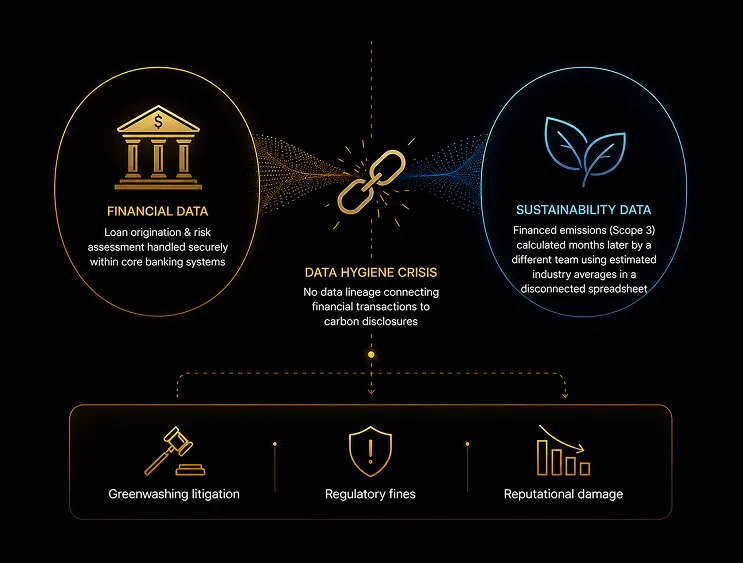
With the deployment of the Zurich and recent Australia platform releases, ServiceNow has explicitly bridged the gap between financial workflows and sustainability metrics. By running both on the unified Now Platform, the CFO gains a single, auditable "Ledger of Truth."
Here is how these modules work together to eliminate the data hygiene crisis:
Connecting Transactions to Impact via a Single Data Model
ServiceNow FSO acts as the operational nervous system for your banking and financial workflows. By integrating it natively with Operational Sustainability Management, the platform automatically maps financial activities (like corporate lending, asset management, or supply chain financing) directly to your established ESG metric definitions. You are no longer estimating your portfolio's carbon exposure; you are calculating it continuously alongside the financial lifecycle of the asset.
Document Intelligence and Now Assist for FSO
One of the largest hurdles in ESG reporting is unstructured data. The latest releases bring Document Intelligence and Now Assist for FSO to the forefront. When a corporate client submits hundreds of pages of loan documentation, utility audits, and compliance certificates, autonomous AI agents can instantly extract both the financial figures and the embedded sustainability metrics. The AI processes this data, verifies it against your Integrated Risk Management (IRM) guardrails, and feeds it directly into your audit-ready reporting dashboards without human transcription errors.
Agentic Workflow Orchestration for Audit Defense
In the 2026 agentic era, compliance is active, not passive. Through the AI Control Tower, CFOs can deploy autonomous agents that continuously audit the health of both financial and non-financial data streams. If a third-party vendor's ESG rating suddenly drops, or if a localized carbon cap is breached, the platform automatically flags the anomaly. The system then generates a proactive remediation workflow, alerting the finance team before the discrepancy makes its way into the quarterly corporate disclosure.
At Mirroar, we understand that CFOs do not want to become IT administrators. You need systems that translate raw, messy data into definitive, audit-proof insights.
When we deploy this unified architecture, we focus on eradicating data silos from day one:
The era of managing ESG as a side-project for the marketing department is over. In 2026, sustainability is a core financial metric.
If your organization is still trying to defend its non-financial disclosures using fragmented spreadsheets, you are exposing your balance sheet to unacceptable risk. By unifying ServiceNow FSO and Operational Sustainability, you empower the CFO's office with the pristine data hygiene, AI-driven speed, and absolute auditability required to lead the modern financial landscape.


