How Frontier Teams Are Reinventing AI-Native Development
For years, enterprise software engineering followed a predictable formula: write deterministic logic, run test suites, deploy through CI/CD pipelines, and patch bugs as they appeared. That paradigm is rapidly shifting. Today, how frontier teams are reinventing AI-native development centers on treating foundation models not as add-on APIs, but as the foundational core of modern software architecture.
This shift isn't just about giving engineers intelligent coding assistants to speed up syntax generation. It requires rebuilding software stacks from the ground up to accommodate non-deterministic behavior, autonomous agent orchestration, and real-time contextual reasoning. Below, we explore the core structural transformations driving this new software lifecycle and how organizations can adapt their engineering cultures to stay competitive.
Architectural Evolution: Moving from Static Pipelines to Adaptive Systems
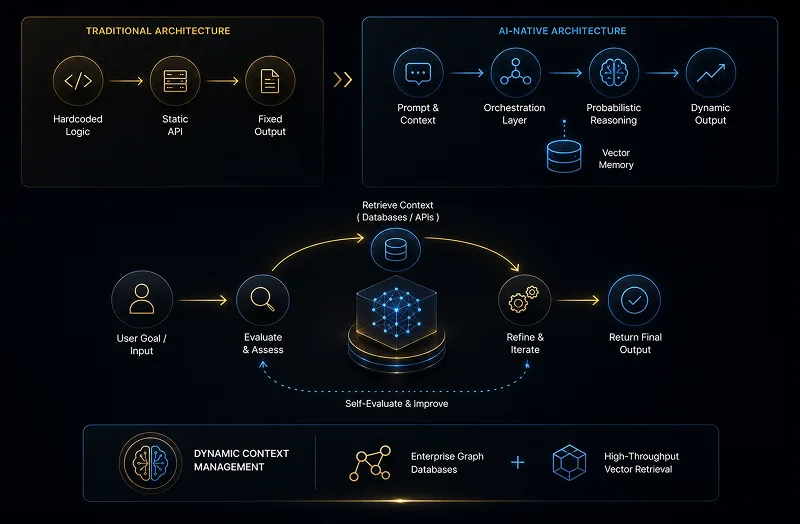
Traditional enterprise architecture relies heavily on rigid, microservice-based boundaries where input $A$ consistently yields output $B$. AI-native development fundamentally breaks this expectation by introducing dynamic, probabilistic reasoning into the application layer.
The Transition to Agentic Workflows
Frontier engineering teams are moving away from simple single-prompt completions toward autonomous agentic loops. In an AI-native system, applications evaluate their own execution, call external databases or APIs when stuck, and iteratively refine outputs before returning them to the user.
Dynamic Context Management
Instead of hardcoding business rules, modern architectures rely on hybrid context engines. By pairing enterprise graph databases with high-throughput vector retrieval, system designers supply foundation models with exact operational knowledge at the point of inference, reducing hallucinations without requiring expensive model retraining.
Redefining the Software Engineering Lifecycle
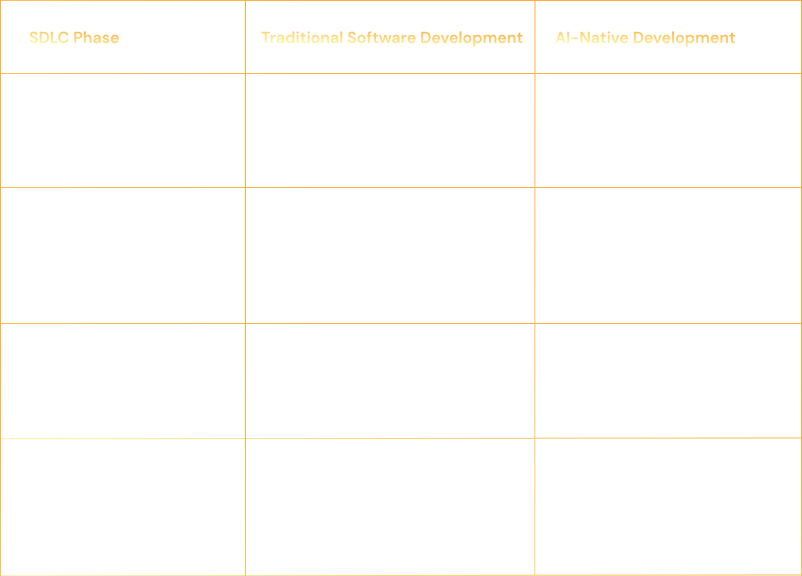
When models write and review code, the traditional software development lifecycle (SDLC) evolves. The bottleneck in software delivery is no longer typing velocity—it is specification clarity and validation speed.
Continuous Benchmark Evaluation
Because probabilistic models can drift over time, testing cannot happen solely prior to release. Leading development organizations maintain continuous evaluation suites (evals) that continuously score live inputs and outputs against quality, security, and brand alignment baselines.
- Internal Linking Opportunity: Discover best practices for building automated benchmark pipelines with [AWS Bedrock Model Evaluation] to ensure enterprise system reliability.
Cultural Shift: Transforming Engineers into System Architects
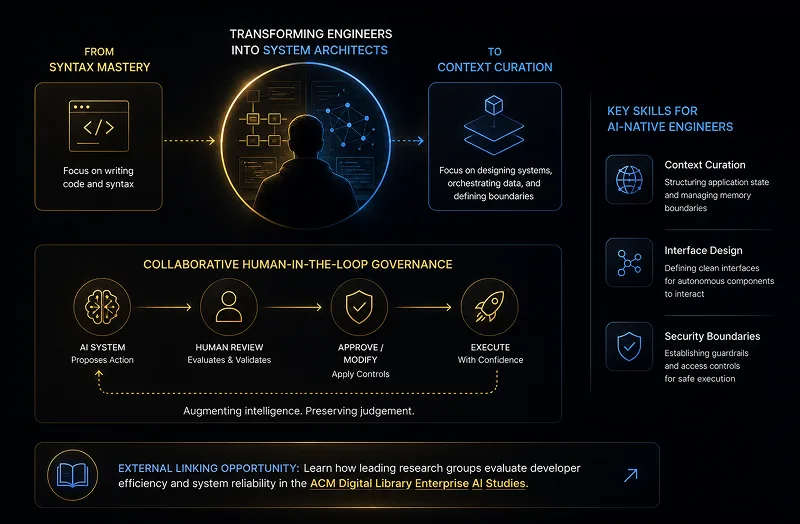
Reinventing development requires more than updating technology stacks; it demands a shift in engineering mindset. When generative tools handle baseline boilerplate generation, human developers elevate their focus toward system design, data orchestration, and security boundaries.
From Syntax Mastery to Context Curation
The most valuable skill in AI-native engineering is no longer deep syntax memorization in a specific programming language. Instead, top teams excel at
context curation—structuring application state, managing memory boundaries, and defining clean interfaces through which autonomous components interact.
Collaborative Human-in-the-Loop Governance
AI systems should augment, not bypass, developer judgement. Frontier teams establish human-in-the-loop checkpoints for high-risk system decisions, balancing execution velocity with operational control.
- External Linking Opportunity: Learn how leading research groups evaluate developer efficiency and system reliability in the [ACM Digital Library Enterprise AI Studies].
Key Takeaways
- Architecture Shifts from Static to Probabilistic: AI-native platforms replace hardcoded logic trees with dynamic agent orchestration and context-rich retrieval layers.
- Quality Control Requires Continuous Evals: Standard unit tests are insufficient for probabilistic outputs; organizations must implement automated, continuous evaluation suites.
- The Developer Role Is Evolving: Engineering impact is increasingly measured by system design clarity, prompt and context orchestration, and guardrail enforcement rather than raw code generation.
- Security Must Be Embedded: Protecting AI-native applications requires defense-in-depth strategies, including real-time input sanitization, output guardrails, and role-based data isolation.
Accelerate Your AI-Native Transformation
Understanding how frontier teams are reinventing AI-native development gives your organization the blueprint to build flexible, high-performing software systems. By modernizing your architecture, adopting continuous evaluation, and reshaping engineering workflows, we can unlock unprecedented agility while maintaining enterprise-grade reliability.
Ready to modernize your engineering stack? Connect with our team of AWS solutions architects today to design and scale your enterprise AI infrastructure.