Safely Releasing Frontier Models to Customers: An Enterprise Framework
The race to deploy generative AI has shifted from basic experimentation to launching massive, cutting-edge foundation systems—often called frontier models. While these systems offer unprecedented capabilities in reasoning and creative generation, they also introduce complex risks ranging from hallucinated guidance to severe privacy breaches. For enterprise leaders and AWS practitioners, safely releasing frontier models to customers is no longer just a technical checkpoint; it is a fundamental business imperative.
Building a secure deployment lifecycle requires balancing rapid innovation with rigorous safety standards. Below, we break down how enterprises can navigate model safety, secure data pipelines, and establish continuous oversight without slowing down development.
The Frontier Safety Spectrum: Risk Identification Beyond Traditional Software
Unlike traditional software, AI models are non-deterministic. The same prompt can produce different outputs based on slight contextual shifts, making standard quality assurance protocols insufficient.
When deploying high-capability models, risk mitigation must cover three critical surfaces:
- Systemic Misuse and Harm: Shielding models from being weaponized for malicious automation, social engineering, or direct bypass of corporate guardrails.
- Data Leakage and Privacy Violations: Preventing training data extraction or unintended regurgitation of proprietary customer information.
- Operational Instability: Managing unexpected model drift, hallucinations, and logic failures in mission-critical applications.
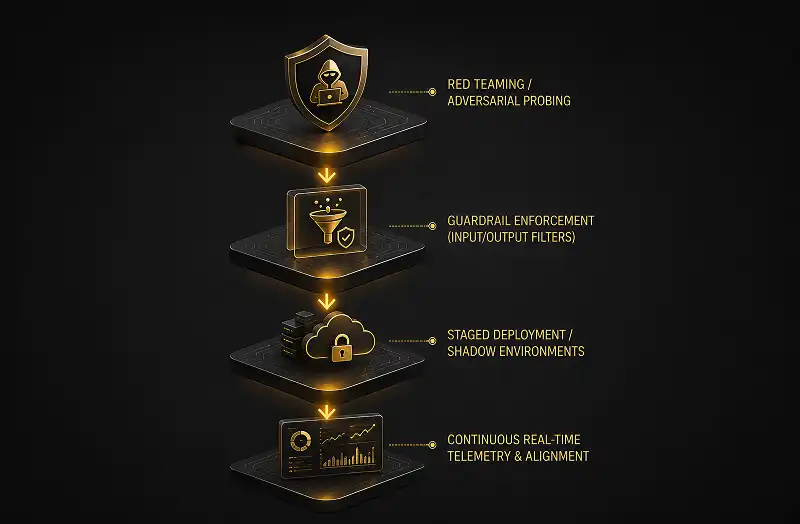
To address these vulnerabilities, organizations must move from passive testing to proactive adversarial testing before customer rollout.
Implementing Multi-Layered Safety Guardrails
Safety cannot rely on model alignment alone (such as Reinforcement Learning from Human Feedback, or RLHF). Fine-tuning helps train the model on general preferences, but operational safety requires a defense-in-depth architecture surrounding the inference pipeline.
Input Sanitization and Prompt Validation
Before a prompt reaches the model, pre-processing filters must analyze the input for malicious intent, prompt injection attacks, or requests for unauthorized data access.
Output Filtering and Topic Redirection
Simultaneously, output guardrails evaluate the generated text in real time. If an output violates safety thresholds, toxic content policies, or PII (Personally Identifiable Information) exposure rules, the system dynamically intercepts the response and returns a safe fallback message.
Red Teaming and Continuous Evaluation Frameworks
You cannot protect against threats you haven't simulated. Enterprise red teaming involves intentionally probing models with adversarial inputs to surface edge-case failures.
Automated vs. Human-Led Red Teaming
Automated Evaluation: Scalable tools run thousands of adversarial prompts through the system to test boundaries on jailbreaks, toxicity, and bias.
Expert Human Probe: Specialized domain experts test complex reasoning pathways, legal compliance boundaries, and multi-step prompt attacks that automated scripts miss.
By pairing automated benchmarking with targeted human evaluation, teams establish a clear metric for model readiness before any public release.
Architectural Control: Isolating and Monitoring Model Access
Safely releasing frontier models requires strict environment controls and fine-grained permissions. Moving a model into production demands clear boundary isolation across data storage, compute, and API endpoints.
Staged Rollouts and Shadow Deployments
Rather than a direct release to all end users, deploy frontier models using progressive traffic shifts. Running a new model in
shadow mode alongside an existing system allows teams to evaluate live production behavior against real-world user queries without exposing end users to potential outputs.
Key Takeaways
- Safety Is Architectural: Frontier model safety relies on surrounding the model with input/output guardrails, fine-grained access policies, and network isolation.
- Proactive Adversarial Probing: Combine automated stress tests with human red-teaming to uncover vulnerabilities before deployment.
- Progressive Exposure: Deploy models gradually using shadow testing and staged rollouts to monitor performance under real-world conditions.
- Continuous Feedback: Safety does not stop at launch; establish real-time telemetry to audit model drift and refine safety boundaries continuously.
Streamline Your Frontier AI Deployments
Safely releasing frontier models to customers requires a balance between speed and control. By establishing multi-layered guardrails and continuous evaluation pipelines, your enterprise can innovate with confidence.
Need help architecting your generative AI infrastructure? Reach out to our team of AWS experts today to audit your AI safety stack and build robust, enterprise-grade deployment pipelines.