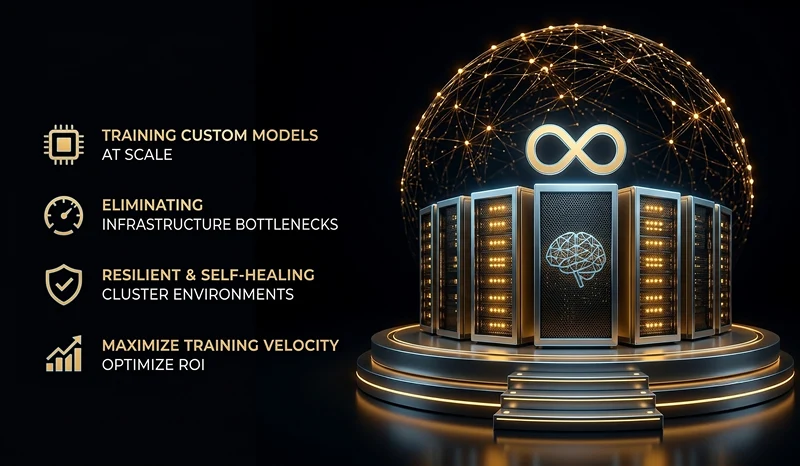
Training Custom Models at Scale: Eliminating Infrastructure Bottlenecks with SageMaker HyperPod
Training custom foundation models and domain-specific Large Language Models (LLMs) represents the pinnacle of modern enterprise AI engineering. When an organization builds proprietary models on its internal dataset, it creates a defensible competitive moat. However, shifting from fine-tuning lightweight models to training multi-billion parameter architectures across massive GPU clusters introduces severe operational friction.
At enterprise scale, training runs are no longer limited by algorithm design, they are constrained by physical compute infrastructure. Hardware faults, inter-node network latency, and memory allocation bottlenecks frequently stall multi-week training jobs, burning hundreds of thousands of dollars in wasted compute time.
Overcoming these distributed compute hurdles through
training custom models at scale: eliminating infrastructure bottlenecks with SageMaker HyperPod has become a primary objective for data science teams and engineering leaders. By leveraging resilient, self-healing cluster environments, enterprises can maintain continuous training velocity while protecting their capital investment.
In this technical strategy guide, we break down why traditional distributed training pipelines fail, how Amazon SageMaker HyperPod solves cluster resilience, and how engineering teams can optimize high-throughput custom model development.
The Reality of Distributed AI Training: Why Legacy Clusters Stall
Training custom foundation models requires coordinating thousands of specialized accelerators, such as AWS Trainium or NVIDIA GPUs, working in parallel across high-speed interconnects. In a perfectly synchronized cluster, data flows seamlessly between compute nodes. In reality, large-scale distributed computing is inherently fragile.
The Cost of Unexpected Cluster Failures
When training a model across hundreds of nodes, the probability of an individual hardware component failing increases exponentially. In standard unmanaged cluster setups, a single node hardware glitch or memory corruption error can cause the entire training job to crash.
- Prolonged Downtime and Manual Intervention: Traditional setups require system administrators to manually identify the failing node, isolate the hardware fault, re-provision a clean instance, and restart the job from the last saved checkpoint.
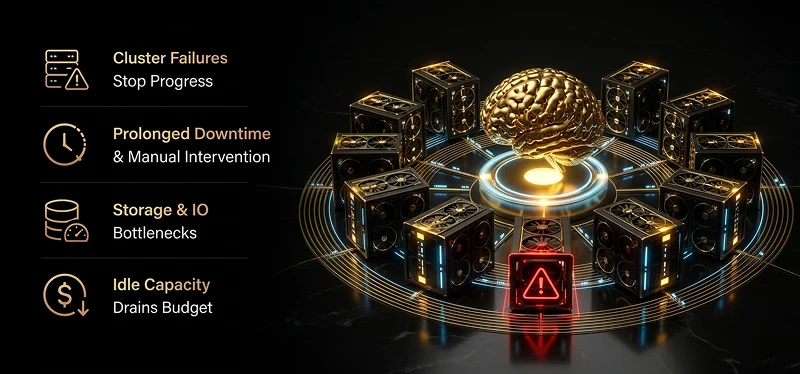
- Storage and IO Bottlenecks: Saving massive model checkpoints to storage every few hours taxes system memory and network bandwidth. If a cluster crashes mid-step, hours of compute time and tens of thousands of dollars are lost instantly.
- Idle Capacity Expenses: While engineers scramble to troubleshoot a node failure, hundreds of healthy GPUs remain idle, consuming budget without processing a single training batch.
Architecting for Resilience: How Amazon SageMaker HyperPod Works
To solve the fragility of large-scale AI infrastructure, AWS developed Amazon SageMaker HyperPod. Rather than treating a cluster as a static group of servers, SageMaker HyperPod delivers a resilient, self-healing environment designed specifically for prolonged distributed training.
How SageMaker HyperPod Eliminates Cluster Friction
SageMaker HyperPod automates the complex cluster management tasks that historically required dedicated systems administration teams. By integrating health monitoring directly into the infrastructure plane, it transforms how high-throughput training jobs execute.
Core Engineering Advantages
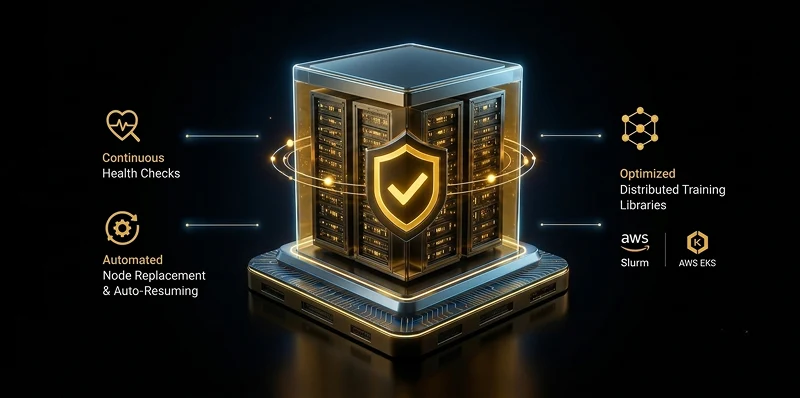
- Continuous Health Checks: SageMaker HyperPod regularly runs background health diagnostics across all active nodes, detecting hardware anomalies, network degradation, and memory leaks before they crash a training step.
- Automated Node Replacement and Auto-Resuming: When a hardware fault is detected, the platform automatically isolates the impaired node, replaces it with a healthy instance, and resumes training from the latest checkpoint without human intervention.
- Optimized Distributed Training Libraries: The platform incorporates specialized data-parallel and model-parallel libraries. These utilities split massive parameter sets across cluster nodes efficiently, minimizing communication latency across high-bandwidth AWS Slurm and AWS EKS environments
Best Practices for Custom Model Development at Enterprise Scale
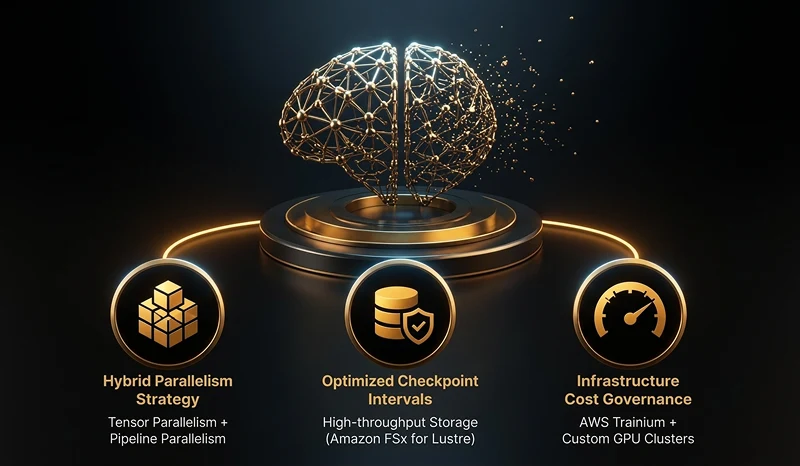
Successfully training custom models at scale: eliminating infrastructure bottlenecks with SageMaker HyperPodinvolves pairing resilient compute hardware with structured architectural choices. At Mirroar, we recommend focusing on three core operational pillars:
Hybrid Parallelism Strategy
Never rely solely on data parallelism when training large models. Combine tensor parallelism (splitting individual layers across GPUs) with pipeline parallelism (partitioning model layers across node groups) to maximize memory efficiency and compute utilization.
Optimized Checkpoint Intervals
Establish automated checkpointing schedules backed by high-throughput storage systems like Amazon FSx for Lustre. By minimizing the time required to write model weights to storage, you reduce IO friction and ensure rapid recovery if an auto-resume event occurs.
Infrastructure Cost Governance
Match your training throughput to the right accelerator family. Utilizing AWS Trainium instances alongside custom GPU clusters allows engineering teams to optimize training costs while maintaining high execution speeds for specific model architectures.
Accelerate Your Custom AI Infrastructure with Mirroar
Building and scaling custom AI models requires deep architectural expertise spanning distributed infrastructure, network fabrics, and model optimization. Eliminating compute bottlenecks is essential for maintaining engineering velocity and protecting your technology investment.
At
Mirroar, we help technology leaders and enterprise engineering teams design, deploy, and optimize high-throughput AWS environments engineered for complex AI workloads.
Ready to eliminate training bottlenecks and scale your custom models efficiently? Connect with our consultative advisory team at
Mirroar today to schedule an AI infrastructure and architecture assessment.